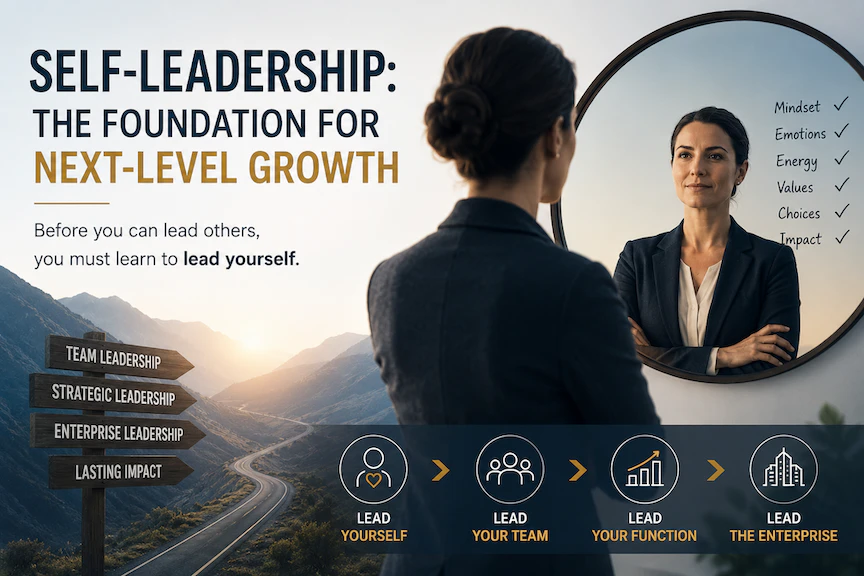
Self-Leadership: The Foundation for Next-Level Growth
Self-leadership is the foundation of leadership growth. Learn why leaders need a practical roadmap for growth from self-leadership to enterprise leadership.

One of the most significant transitions in a leadership career has nothing to do with title, compensation, or organizational chart position. It has everything to do with identity.
Many high-performing professionals earn promotions because they consistently deliver exceptional results. They're the ones who solve problems faster, think more clearly under pressure, and execute with precision. Ironically, those very qualities—the behaviors that earned the promotion—can become the greatest barriers to success once the responsibility shifts to leading others.
The research is sobering. According to Gartner and CEB, 60% of new managers fail within their first 24 months. More than 75% of newly promoted leaders report feeling unprepared for the role they were just handed. And yet organizations continue promoting top performers into leadership positions with minimal transition support, assuming that competence in execution naturally translates into competence in leadership.
It doesn't.
The shift from doing to enabling is the first true leadership multiplier—and learning to make that shift deliberately is what separates managers who survive from leaders who transform.
When you're an individual contributor, your value is measured by your expertise, your output, and your responsiveness. You are paid to have answers and deliver results.
As a team leader, your value shifts fundamentally. You are no longer the primary producer. You are the architect of conditions that allow others to produce.
That distinction sounds simple. In practice, it is one of the most difficult cognitive and behavioral shifts a leader can make.
Effective leaders stop asking, "How can I solve this?" and start asking, "How can I create an environment where my team solves this—together?"
That single mindset shift changes everything. It redefines success, reframes accountability, and repositions the leader's role from expert to enabler. For many high-achievers, it also requires a willingness to tolerate discomfort—to watch someone struggle with a problem you could solve in minutes, and to resist the impulse to intervene.
For HR leaders and organizational decision-makers, this signals a critical design question: Are your development and promotion pathways equipping future leaders with enablement skills, or simply rewarding execution? The difference has measurable consequences for team performance, retention, and engagement.
New leaders often feel invisible pressure to prove themselves. They jump into projects early, correct work before it's finished, answer every question before the team has a chance to wrestle with it, and approve decisions that should rightfully belong to someone else.
These behaviors are usually well intentioned. But they send a message that quietly undermines everything a new leader is trying to build:
"I trust myself more than I trust you."
Gallup's research offers one of the most consequential data points in modern leadership: 70% of the variance in team engagement is determined solely by the manager. Not company culture. Not compensation. Not organizational structure. The manager. That statistic carries enormous weight—both as an opportunity and as an obligation.
High-performing teams are built on trust, and trust is cultivated through consistent behavior over time. In practice, that means:
Delegation isn't about getting tasks off your plate. It's about developing the capacity of the people around you. Leaders who hold on to everything stunt the growth of their teams—and exhaust themselves in the process.
In 2012, Google launched one of the most ambitious internal research projects in corporate history. Code-named Project Aristotle, the initiative set out to identify what made some Google teams significantly more effective than others. Led by researcher Julia Rozovsky, the project studied 180 teams across engineering and sales, analyzing more than 250 distinct attributes over two years.
Their initial hypothesis? That the most effective teams would be composed of the highest performers, led by the most experienced managers, with the greatest access to resources.
They were wrong.
What the data actually revealed was that team composition mattered far less than team dynamics. And the single most important dynamic? Psychological safety.
This finding aligned closely with the foundational work of Harvard Business School professor Amy Edmondson, whose 1999 study published in the Administrative Science Quarterly introduced psychological safety as a measurable predictor of team learning and performance. Edmondson defines it as a shared belief among team members that the environment is safe for interpersonal risk-taking—that people can ask questions, admit mistakes, challenge assumptions, offer new ideas, and disagree respectfully without fear of embarrassment, punishment, or humiliation.
The implications for leadership are direct and practical. Leaders set the tone for psychological safety every single day, through the questions they ask, the reactions they model, and the behaviors they reward or ignore.
Questions that signal psychological safety in action:
When disagreement becomes welcome rather than dangerous, creative tension replaces conflict avoidance. When mistakes are treated as learning opportunities rather than performance failures, people stop hiding problems and start solving them. Innovation follows naturally—not as a stated organizational value, but as a byproduct of an environment where people feel genuinely safe to contribute.
For HR decision-makers, the organizational design question becomes: Are your management practices systematically building or eroding psychological safety across teams? The answer will show up in your engagement data long before it surfaces in your attrition metrics.
One of the most persistent myths in leadership is that effective leaders are consistent in their style. The reality is more nuanced—and more demanding.
The Situational Leadership® model, developed by Dr. Paul Hersey and Ken Blanchard, offers one of the most practical frameworks for understanding why a single leadership approach will always underserve someone on your team. The model proposes that leaders should assess each team member's level of ability and willingness for any given task, then intentionally adjust the degree of direction and support they provide.
The four core styles are:
What this model makes explicit is that the same person may require different leadership approaches for different tasks. An experienced team member who thrives with autonomy on strategic projects may need coaching support when learning an entirely new skill set. A new hire who requires close guidance in the first month may be ready for significantly more independence by month six.
Leadership isn't consistency in style. It's consistency in purpose—a steadfast commitment to helping each person succeed—while remaining fluid enough to meet people where they are.
Inclusive leadership is sometimes misunderstood as a compliance obligation or a diversity metric. It is neither. It is a performance strategy.
Teams make better decisions when more perspectives are genuinely included in the process. That isn't a philosophical claim—it's an empirical one. Research examining the relationship between inclusive leadership, psychological safety, and team innovation performance has found that inclusive leadership behaviors meaningfully predict both team psychological safety and innovative outcomes.
Inclusive leaders don't wait for diverse voices to speak up. They actively create conditions where speaking up is normalized and valued. In practice, that looks like:
Inclusion is not a leadership style reserved for certain teams or certain industries. It is a foundational practice for any leader serious about building a team that consistently outperforms.
Consider Sarah, a newly promoted manager stepping into leadership of a team that, just weeks earlier, were her peers.
She was talented, well-regarded, and deeply committed to her team's success. She wanted everyone to feel supported. She wanted everyone to like her. And so she did what came most naturally: she kept solving problems.
When a team member struggled, Sarah stepped in. When a decision needed to be made, Sarah made it. When a difficult conversation loomed, Sarah avoided it—choosing harmony over accountability. She stayed late fixing mistakes herself rather than addressing them directly. She said yes to almost every request because saying no felt like letting people down.
Within months, the symptoms were unmistakable. Sarah was overwhelmed and exhausted. Her team had become dependent on her for decisions they were fully capable of making themselves. Accountability had quietly eroded. And beneath the surface, resentment was growing—from team members who felt they weren't trusted, and from Sarah herself, who felt increasingly isolated in her role.
Through executive coaching, Sarah began to examine the patterns holding her back. She recognized that her over-helpfulness wasn't kindness—it was control dressed in the language of support. She was confusing being needed with being effective.
She made several deliberate, practical changes:
Six months later, the results were tangible. Team members were taking greater initiative. Engagement improved measurably. Difficult conversations—the ones Sarah had been avoiding—were happening earlier, more directly, and with less friction than she had feared. And for the first time since her promotion, Sarah felt like she was leading rather than simply working harder.
Sarah's story isn't exceptional. It's representative of what happens when capable professionals are promoted without being equipped for the identity shift that leadership actually requires—and what becomes possible when they receive the support to navigate it intentionally.
Leadership transformation doesn't require a complete overhaul. Small, intentional practices—applied consistently—produce the most durable impact.
Move beyond status updates. Structure your regular one-on-ones around four core areas:
These conversations build trust over time. They signal that you are invested in each person, not just in their output.
Timely, specific feedback is one of the highest-leverage tools available to any leader. Use this four-step structure:
This approach keeps feedback grounded in observable behavior rather than personality—which makes it easier to hear and easier to act on.
Effective delegation is not task assignment. It is outcome agreement. When delegating:
Unaddressed conflict doesn't disappear. It compounds. When tension arises:
Build inclusion into your team's regular rhythms:
Before this week closes, challenge yourself to complete at least one of the following:
Create a Delegation Map. List every significant responsibility currently on your plate. For each one, ask: Should this belong to me? Could this develop someone else? What would need to be true for me to transfer this over the next 30 days? The answers will reveal more about your leadership patterns than any formal assessment.
Conduct a Psychological Safety Pulse Check. Ask your team—individually or as a group—two direct questions: What makes it easier for you to speak openly? and What gets in the way? Listen without defending. The information you receive is a gift.
Rehearse a difficult conversation. Identify a conversation you've been avoiding. Write out what you want to say, anticipate how it might be received, and practice it aloud before you have it. Preparation converts avoidance into action.
Revisit your team's operating norms. Do your team members share a clear understanding of how decisions get made, how conflict gets addressed, and how accountability is defined? If not, creating that clarity together is one of the highest-value investments of your leadership time.
Leadership growth begins with the willingness to look clearly at your current reality. Set aside time this week to sit with these questions:
The gap between how we intend to lead and how our teams actually experience us is one of the most important pieces of intelligence a leader can access. Closing that gap—consistently and honestly—is where real leadership development happens.
The best leaders are not remembered because they carried their teams through difficulty. They are remembered because they built teams capable of succeeding—long after the leader stepped out of the room.
Leadership is not about becoming indispensable. It is about making the people around you more capable, more confident, and more effective than they would have been without your influence.
That is the multiplier effect. And it begins—not with a strategy or a system—but with a decision to lead differently than you were led, and more intentionally than your promotion prepared you for.
The practical tools in this article are your starting point. The Delegation Map will show you where you're holding on. The Psychological Safety Pulse Check will surface what your team hasn't yet felt safe enough to say. The feedback framework will equip you to have the conversations that strengthen relationships rather than strain them.
Use them. Revisit them. Build them into your leadership rhythms.
Because team leadership, practiced with intention, is not simply the first chapter in your leadership journey. It is the foundation everything else is built on.
BONUS: Reach out to us for a complimentary example of a Delegation Map!
Sign up for our blog now so you never miss out on our expert advice and tips.