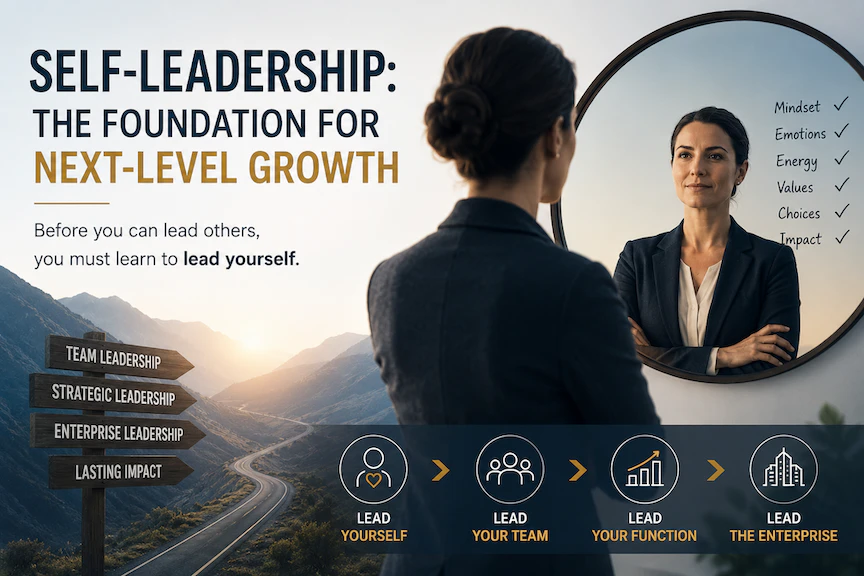
In leadership development, people often focus on the visible parts first—communication, delegation, executive presence, strategic thinking, and influence. These are all important. But too often, leaders and organizations overlook the foundation that supports every one of those capabilities: self-leadership.
Before a leader can effectively guide a team, influence peers, shape strategy, or lead an enterprise, they need to first learn to lead themselves.
That may sound simple. In practice, it is not.
Self-leadership is more than personal discipline or productivity. It’s the ability to manage your mindset, emotions, energy, behavior, and choices in ways that align with your values and support your goals. It is the inner work of leadership—the part no one sees directly, but everyone feels through your presence, decisions, and impact.
Why Self-Leadership Is Foundational
Many leaders are promoted because they’re smart, capable, dependable, and driven. They know how to perform. They know how to deliver. They know how to get things done.
But leadership growth eventually asks for more than performance.
It asks:
· Can you stay grounded under pressure?
· Can you regulate yourself in emotionally charged moments?
· Can you respond with intention instead of reacting on autopilot?
· Can you align your leadership behavior with the values you say matter most?
· Can you sustain your effectiveness without burning yourself out?
These are self-leadership questions.
Without self-leadership, even talented leaders can become reactive, overextended, defensive, controlling, or disconnected from the very people they are trying to lead. The problem is not usually a lack of intelligence or work ethic. More often, it’s a lack of inner alignment.
That is why I view self-leadership not as a soft beginning point, but as the core operating system of effective leadership.
The Cost of Skipping the Foundation
When self-leadership is underdeveloped, leaders often compensate in ways that look productive on the surface but create strain underneath.
· They overwork instead of prioritizing.
· They control instead of trusting.
· They react instead of reflecting.
· They push through instead of recalibrating.
· They lead from urgency instead of intention.
Over time, that pattern catches up with them.
I’ve seen this while coaching high-performing leaders across diverse industries. Many are deeply committed and exceptionally capable. Yet they feel overwhelmed, fatigued, or frustrated by the increasing complexity of leadership. Some begin doubting themselves. Others become so focused on keeping up that they lose sight of how they want to lead.
Often, the issue isn’t that they need more motivation. It’s that they need a stronger foundation.
Self-Leadership Is the First Level, Not the Final Lesson
One of the biggest misconceptions in leadership development is that self-leadership is only for emerging leaders. In reality, self-leadership remains essential at every stage of leadership growth.
· The senior executive navigating uncertainty needs it.
· The manager leading former peers needs it.
· The functional leader balancing strategy and execution needs it.
· The enterprise leader shaping culture and direction needs it.
As scope increases, the demands on the leader’s internal capacity increase as well.
That is why self-leadership is both the first level of development and a lifelong practice. The most effective leaders continue doing the inner work. They deepen self-awareness. They examine their patterns. They reflect on their impact. They become more intentional over time, not less.
Why Leaders Need a Roadmap
Leadership growth is not automatic.
Success at one level doesn’t guarantee success at the next. In fact, one of the great challenges of leadership is that the strengths that helped you succeed in one role can become limitations in another.
· The leader who succeeds through personal drive may struggle to delegate.
· The leader who builds trust through harmony may avoid accountability.
· The leader who rises through expertise may struggle to think beyond the function.
· The leader who gains recognition for decisiveness may miss the value of reflection and broader perspective.
This is why leaders need more than encouragement. They need a roadmap.
A roadmap helps leaders understand that leadership is developmental. It changes as responsibility expands. It clarifies that each stage of leadership requires not only new skills, but new ways of thinking, relating, and leading.
Most importantly, a roadmap helps leaders name the shift they’re being asked to make.
Without that clarity, many leaders misdiagnose the problem. They assume they need to work harder, move faster, or control more. In reality, the next level may require them to slow down, trust more, reflect more deeply, or lead through others rather than through sheer effort.
From Self-Leadership to Broader Influence
At the foundation of any meaningful roadmap is self-leadership.
Why? Because every next-level leadership challenge eventually comes back to the leader’s ability to manage self.
· To give effective feedback, you need emotional regulation.
· To build trust, you need self-awareness.
· To delegate well, you need confidence and restraint.
· To lead through uncertainty, you need steadiness and perspective.
· To shape culture, you need alignment between your message and your behavior.
Self-leadership makes these possible.
It’s where leaders begin to understand their values, triggers, habits, patterns, and internal narratives. It’s where they learn to shift from reaction to intention. It’s where they strengthen resilience without disconnecting from their humanity.
That’s not small work. It’s foundational work.
Practical Questions for Self-Leadership Growth
Leaders who want to strengthen self-leadership can begin with a few honest questions:
· What patterns show up in me under pressure?
· Where am I reacting instead of responding?
· What values do I say matter most, and how consistently am I living them?
· What drains my energy and effectiveness?
· What conversations, decisions, or responsibilities am I avoiding?
· Where might my strengths be overused?
· How do others experience me when I’m stretched?
These questions are not about self-criticism. They’re about self-awareness. And self-awareness is one of the most practical assets a leader can develop.
A Better Way to Develop Leaders
Organizations also have a role to play here.
Too often, leadership development focuses on external competencies while overlooking the inner capacities that make those competencies sustainable. Workshops may teach communication, conflict management, or strategy, but without reflection and self-leadership, leaders often struggle to apply those lessons consistently when pressure rises.
A stronger approach is to develop leaders from the inside out.
That means helping them build:
· Self-awareness
· Emotional regulation
· Values clarity
· Personal accountability
· Resilience
· Reflective capacity
These aren’t “extra” leadership skills. They’re the conditions that support every other level of leadership growth.
Final Thought
If leadership is going to grow in a healthy, sustainable way, it has to start with the leader within.
Self-leadership isn’t glamorous. It doesn’t always receive the same attention as executive presence or strategic vision. But it’s the foundation beneath both. When leaders strengthen self-leadership, they do more than improve their own performance. They build the capacity to lead others with greater steadiness, trust, wisdom, and impact.
And when leaders pair that self-awareness with a clear developmental roadmap, growth becomes more intentional.
That’s where leadership development gets real.
That’s where the next level begins.