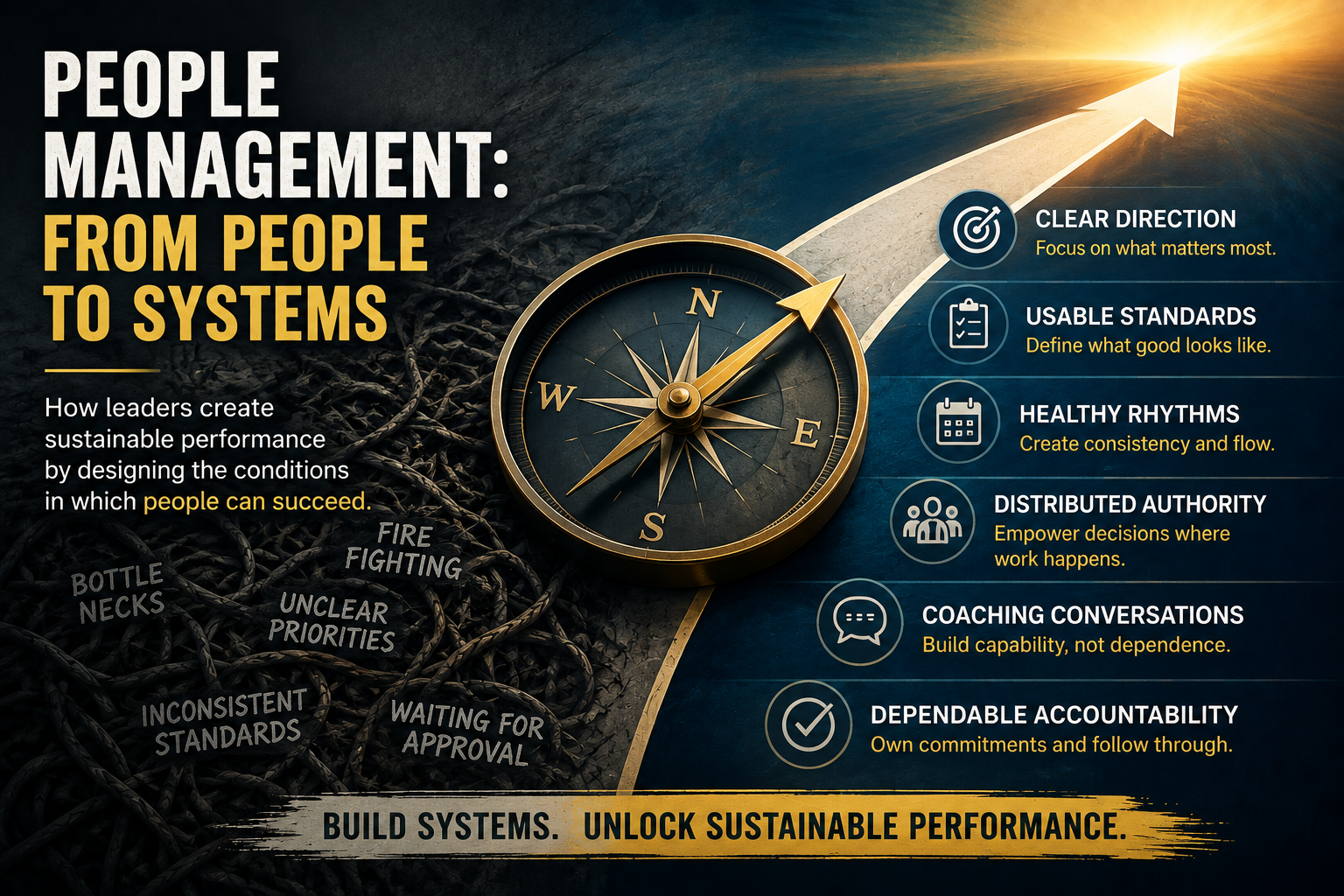
People Management: From People to Systems (How leaders create sustainable performance by designing the conditions in which people can succeed.)
The promotion into management is often described as a move from doing the work to leading people. That is true, but it is incomplete. The deeper transition is from managing individual effort to designing a reliable system of performance.
Early in a career, responsiveness is a strength. You see a problem, step in, and solve it. People learn that you can be counted on. Then you become the manager, and the same instinct can quietly become the team's operating model: questions travel upward, decisions wait for you, standards change with your attention, and urgent work repeatedly displaces important work.
The result is usually not a people problem. It is an architecture problem.
People management at the next level is the work of creating clear priorities, usable standards, healthy rhythms, distributed authority, honest feedback, and dependable accountability. It is still deeply human. But it becomes sustainable only when the human conversations are supported by a system that does not depend on the manager's memory, mood, availability, or heroics.
The Real Shift: From Supervision to Performance Architecture
Direct supervision focuses on the person in front of you: What are they doing? Do they need help? Did they complete the task? Performance architecture asks a broader question: What conditions must be true for this team to deliver good work consistently, learn quickly, and recover when circumstances change?
Think of performance architecture as the team's operating environment. It connects five elements:
· Direction: a small number of priorities that tell people what matters now.
· Standards: a shared definition of quality, behavior, and completion.
· Rhythms: recurring moments to plan, coordinate, review, decide, and learn.
· Accountability: visible ownership, decision authority, commitments, and follow-through.
· Coaching: conversations that build judgment and capability rather than dependence.
The Center for Creative Leadership describes effective leadership outcomes as direction, alignment, and commitment. That is a useful test for any management system: Do people know where we are going? Can they coordinate their work? Do they feel mutual responsibility for the result? [5]
If the team can perform only when you are present, you have built dependence - not capacity.
This is not an argument for less care, less contact, or less leadership. It is an argument for moving your attention upstream. Instead of repeatedly correcting the same downstream failures, improve the agreements, tools, decision rights, feedback loops, and learning practices that shape performance before the failure occurs.
Why This Matters More Than Most Managers Realize
Gallup reports that managers account for 70% of the variance in team-level engagement. [1] That does not mean the manager controls every outcome. It means the daily experience of clarity, support, recognition, feedback, and growth is shaped disproportionately by how the manager leads.
The performance implications are substantial. Gallup's manager-development research reports that managers trained in coaching and people development see up to 18% higher engagement among their teams, while its broader engagement meta-analysis shows meaningful differences between the most- and least-engaged teams, including 23% higher profitability and 18% higher sales productivity. [2]
The message is not that engagement replaces performance. The message is that a well-managed environment makes high performance more repeatable. Clear expectations and candid feedback reduce rework. Decision authority reduces delay. Strong routines reduce surprises. Coaching improves judgment. Accountability keeps commitments visible without turning the manager into the team's full-time monitor.
Build the System: Five Management Disciplines
1. Establish a Clear Priority System
A list of ten priorities is not a priority system. A useful system distinguishes what matters most now, what can wait, what tradeoffs are acceptable, and what work should stop. People should be able to use it when the manager is unavailable.
· Name the three to five outcomes that matter most for the current cycle.
· Translate each outcome into an observable result, not an activity list.
· Clarify what will be deprioritized when new work enters the system.
· Review priorities often enough to keep them real, but not so often that every week feels like a reset.
A strong manager does not simply announce priorities. The manager helps the team understand why they matter and how to make choices when priorities compete.
2. Define Standards That People Can Use
Standards turn personal preferences into shared expectations. They answer questions such as: What does good look like? What must be true before this work is considered complete? Which behaviors are nonnegotiable? When should someone escalate?
The key is to make standards specific enough to guide action and flexible enough to allow judgment. If standards live only in the manager's head, feedback feels arbitrary. If standards are excessively detailed, the system becomes bureaucracy. The practical middle ground is a concise set of quality criteria, behavioral norms, service commitments, and decision boundaries that people can actually remember and apply.
3. Create Rhythms That Carry the Work
Healthy teams do not rely on constant interruption to stay coordinated. They use a small number of recurring rhythms, each with a clear purpose. A rhythm is not just a meeting; it is a reliable feedback loop.
· Weekly priority review: What matters most, what changed, and where are the risks?
· Brief operating check-in: What is on track, off track, blocked, or waiting for a decision?
· Regular one-on-one: What support, feedback, development, or reset is needed?
· Monthly performance review: What patterns are visible in results, quality, capacity, and commitments?
· Quarterly learning review: What should the team continue, stop, redesign, or practice next?
The goal is not to add meetings. It is to replace scattered follow-up, repeated status requests, and last-minute rescue with a predictable cadence for attention and decision-making.
4. Make Accountability Visible and Fair
Accountability is often misunderstood as pressure applied after disappointment. In a healthy system, accountability begins before the work starts. People know the outcome, owner, authority, deadline, checkpoints, and evidence of completion.
CCL's research-based guidance emphasizes the conditions that support ownership: support, freedom, information, resources, and clarity. [6] Remove those conditions and accountability becomes blame. Build them well and accountability becomes a shared promise about results.
· One accountable owner for each outcome - even when many people contribute.
· Decision rights that distinguish recommend, decide, approve, and inform.
· Commitments recorded where the team can see them.
· Checkpoints scaled to risk, experience, and reversibility.
· Consequences that are timely, proportional, and consistently applied.
5. Coach for Judgment, Not Just Compliance
Harvard Business Review has argued that command-and-control management is increasingly inadequate in complex, fast-changing work. In the leader-as-coach model, managers facilitate problem solving and development by listening, asking questions, and offering the right mix of support and guidance. [3]
The Center for Creative Leadership offers a practical sequence through its LACE model: listen to understand, ask powerful questions, challenge and support, and establish next steps and accountability. [4] The last step matters. A warm conversation that produces no commitment may feel supportive, but it does not improve the system.
Daniel Goleman's research on more than 3,000 executives found that effective leaders use multiple leadership styles and flex them to the situation. [7] Coaching is powerful, but it is not the only answer. A crisis may require direct instruction. A capable expert may need autonomy. A new employee may need structure and demonstration. Sustainable management requires range - and the self-awareness to know which response you are defaulting to.
The Four Traps That Keep Managers Stuck
The Heroics Trap
The manager becomes the fixer, closer, editor, rescuer, and final quality check. In the short term, the work gets done. In the long term, the team waits, the manager burns out, and no one develops the judgment required to carry more responsibility.
Coaching move: Before stepping in, ask, 'What is the smallest intervention that will protect the outcome and still leave ownership with the person doing the work?'
The Inconsistency Trap
Expectations change by person, pressure level, or day of the week. Strong performers receive freedom; struggling performers receive attention; steady contributors receive neither. Exceptions multiply until the team no longer knows which standards are real.
Coaching move: Separate flexibility from favoritism. Adapt support to the person while keeping the purpose, standards, and consequences understandable and fair.
The Confusion Trap
Everyone is busy, but people are solving different versions of the problem. Goals are stated as activities. Decision rights are vague. Meetings produce discussion without clear ownership. Confusion is then misdiagnosed as resistance or low performance.
Coaching move: Ask the team to restate the outcome, owner, standard, and next decision in their own words. If those answers differ, repair the agreement before evaluating the people.
The Bottleneck Trap
The manager approves every choice, joins every meeting, and remains copied on every message. People learn that speed is risky and waiting is safe. The manager becomes overloaded precisely because the system has been trained to route work upward.
Coaching move: Define decision boundaries by risk and reversibility. Push routine, reversible decisions closer to the work. Reserve escalation for decisions with significant legal, financial, reputational, safety, or strategic consequences.
A Composite Coaching Case: From Helpful to Scalable
Marcus led a rapidly growing client-services team. He was trusted, experienced, and generous with his time. He reviewed nearly every proposal, joined difficult client calls, reassigned work when deadlines slipped, and answered team messages late into the evening. His leaders saw commitment. His team saw safety. Marcus felt indispensable.
Then growth exposed the cost. Client work waited for his approval. Two capable managers hesitated to make decisions because Marcus often revised them afterward. Standards varied by project. One-on-ones became status meetings. When an experienced employee resigned, the team discovered that key knowledge lived in private messages and in Marcus's memory.
In coaching, Marcus first wanted better time-management techniques. The more useful question was different: 'What has the team learned to depend on you for - and which of those dependencies should become a system?'
Over the next 90 days, Marcus and his team redesigned how work moved:
· They selected four quarterly outcomes and created a visible weekly priority board.
· They defined proposal quality standards and a short pre-submission checklist.
· They assigned decision authority by client risk, contract value, and reversibility.
· They replaced daily ad hoc approvals with two scheduled decision windows.
· They reframed one-on-ones around priorities, obstacles, feedback, development, and support.
· They held a monthly learning review focused on patterns rather than blame.
The transition was not immediately comfortable. Marcus had to tolerate different methods, and his managers had to practice judgment in public. One proposal needed rework. A client issue was escalated later than Marcus would have preferred. The team reviewed both without shaming anyone and adjusted the decision rules.
By the end of the quarter, routine approvals moved faster, managers brought recommendations instead of open-ended problems, and Marcus spent more time on capacity, talent, and client strategy. The most important change was not that Marcus worked fewer hours. It was that the team could now perform well without waiting for him to make the system work.
Practical Management Tools You Can Use This Week
The Performance Architecture Canvas
For one team or workstream, complete these six lines on a single page:
1. Outcome: What result must be true, by when?
2. Priorities: What matters most now, and what will not be done?
3. Standards: What does good look like?
4. Ownership: Who is accountable, and who contributes?
5. Authority: What can the owner decide without approval?
6. Rhythm: When will we coordinate, review, decide, and learn?
The Four-Question One-on-One
· Priorities: What deserves your best attention before we meet again?
· Obstacles: What is getting in the way, and what have you tried?
· Development: What judgment, skill, or relationship are you building?
· Support: What do you need from me - clarity, access, coaching, a decision, or removal of a barrier?
The Accountability Contract
Before significant work begins, confirm the result, owner, standard, authority, deadline, checkpoints, dependencies, and evidence of completion. Ask the owner to summarize the agreement. That brief step prevents many of the conversations managers later label as accountability problems.
The Rescue Pause
When someone brings you a problem, pause before solving it. Ask:
· What outcome are you trying to protect?
· What do you believe is causing the problem?
· What options have you considered?
· What decision is yours to make?
· What specific support do you need from me?
If the person lacks knowledge, teach. If authority is unclear, clarify it. If a barrier sits outside their control, remove it. If they have the capability and authority, return the decision with confidence.
The Monthly System Review
Once a month, review the operating system - not just the operating results. Which delays, errors, escalations, or conflicts are repeating? Which standard is unclear? Which meeting no longer serves its purpose? Which decision is traveling too high? Which capability needs practice? Improve one part of the architecture rather than launching a complete overhaul.
Questions for Reflection
Sustainable management begins with honest observation. Consider these questions without rushing to defend your current approach:
· Where does work slow down because the team is waiting for me?
· Which priorities are truly clear - and which are merely familiar to me?
· What standards live in my head instead of in a shared agreement?
· Where have I mistaken rescuing for coaching?
· Which team member needs more direction, and who needs more room?
· What commitments are invisible until they are missed?
· How consistently do I address strong performance, missed expectations, and learning?
· If I were unavailable for two weeks, what would continue smoothly - and what would break?
· What does my current management system teach people about initiative, candor, and ownership?
Leadership in Action: Development Activities
Choose one or two activities. Practice them long enough to learn from the result before adding more.
1. Map the Bottlenecks
For five working days, record every request that requires your approval, answer, correction, or rescue. At week's end, sort the requests into four categories: unclear priority, unclear standard, unclear authority, or capability gap. Redesign the most frequent category.
2. Build One Operating Rhythm
Select one recurring need - priorities, decisions, one-on-ones, performance, or learning. Define its purpose, participants, cadence, preparation, and output. Pilot it for four weeks, then ask the team what to keep, change, or stop.
3. Transfer a Complete Outcome
Delegate one outcome, not merely a collection of tasks. Clarify the result, constraints, decision rights, checkpoints, and learning goal. Notice every impulse to retake the work. Intervene only at the level required by risk and development.
4. Practice a Coaching Conversation
Use the LACE sequence in one real conversation: listen to understand; ask questions that expand thinking; challenge and support; establish a specific next step and accountability. Afterward, reflect on the ratio of your questions to your advice.
5. Conduct a Standards Calibration
Bring two examples of completed work - one strong and one that required rework. Ask the team to identify the observable differences. Turn those observations into a short quality standard or checklist, and revisit it after the next three uses.
6. Run a 30-Day Manager Experiment
Choose one behavior to reduce and one to increase. For example: reduce immediate answers; increase questions that clarify ownership. Tell the team what you are practicing, invite feedback, and review the evidence after 30 days.
The Leadership Multiplier
People management is not the art of keeping every person satisfied or every variable under control. It is the disciplined, human work of creating conditions in which people know what matters, understand what good looks like, have appropriate authority, receive useful coaching, and follow through on shared commitments.
The leader remains essential - but in a different way. Your value is no longer measured only by the problems you solve. It is measured by the clarity you create, the capability you build, the decisions you distribute, the standards you protect, and the system your team can carry forward.
That is the movement from people to systems. It does not make management less personal. It makes good management more consistent, more fair, and more sustainable.
Get Practical and Actionable Insights Delivered Monthly
Sign up for our blog now so you never miss out on our expert advice and tips.
Other Blogs

Team Leadership: The First Multiplier
Self-Leadership: The Foundation for Next-Level Growth